A working life inside small business
My useful qualification was never one certificate. It was the sequence: banking, foreign exchange, computing, accounting systems, building a company, losing it, and then spending decades listening to thousands of other owners describe what happened inside theirs.
1970s: medicine, then banking
I studied medicine at UCT and left after a motor accident. I moved into banking, studied through the Institute of Bankers and qualified CAIB(SA). Foreign exchange became my speciality and gave me an early education in money, risk, documentation and the consequences of commitments made today but settled later.
Samancor: the computer room changed everything
I joined Samancor, then a large South African mining group, to work with foreign exchange. Their mines used IBM System/34 computers and common accounting software. I walked into the computer room, saw where business was going and asked the data-processing manager how I could join him. An aptitude test led to a move into his department, where I learned RPG programming and accounting systems.
1984–1992: Link Technologies
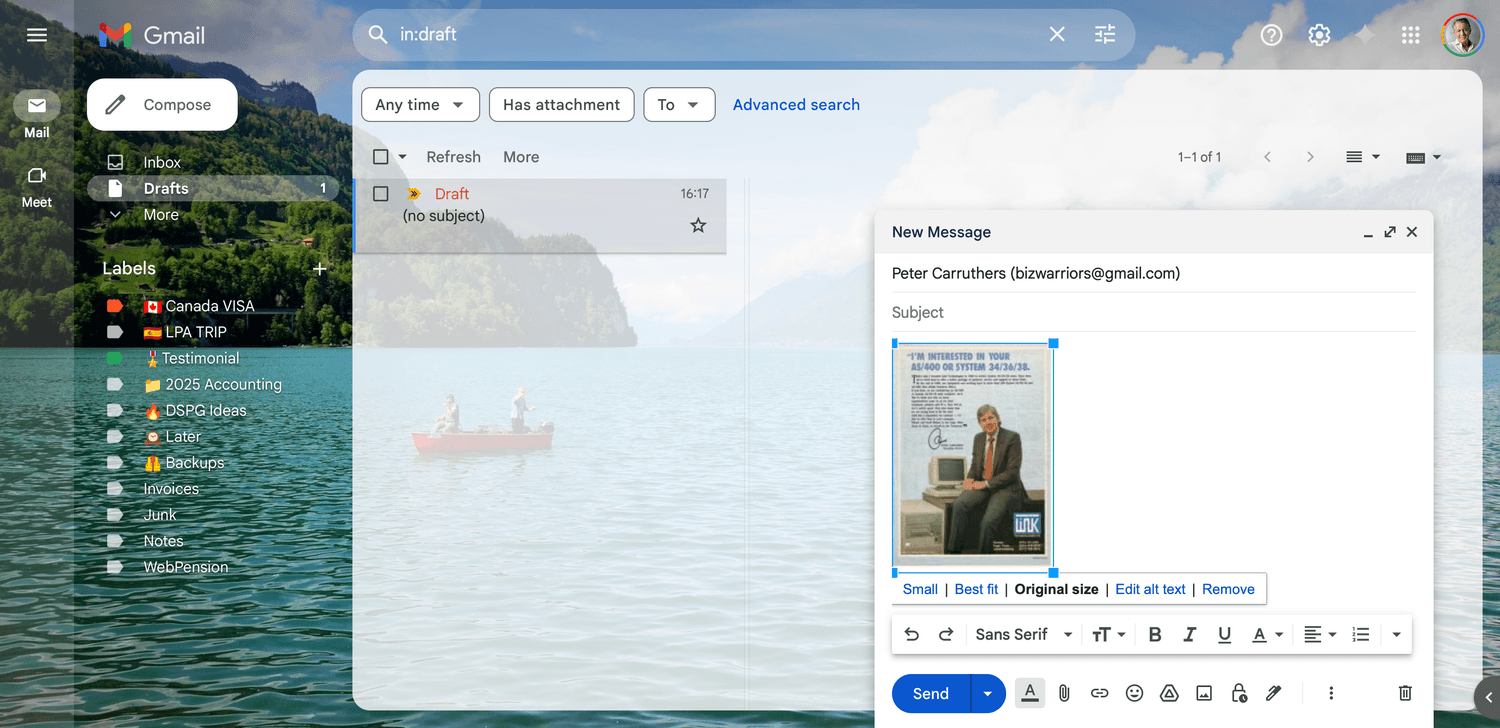
I founded Link Technologies in 1984. What began as a tiny operation grew into a specialist supplier serving IBM mid-range computer users across Southern Africa. By the end of the 1980s we had worked with hundreds of System/34, System/36, System/38 and AS/400 sites, and had offices in Durban, Johannesburg, Cape Town and Port Elizabeth.
The marketing lesson mattered as much as the technology. We used direct marketing continuously: letters, then faxes, then email. It taught me that a small company can compete with far larger firms when it owns the route to its customers.
1992: the company closed. The guarantees did not.
The economic downturn caught us with commitments that were much harder to reverse than the business itself. Link Technologies closed in 1992. I discovered, painfully, that a limited company can disappear while personal guarantees, leases, supplier obligations and bank commitments continue following the owner home. That experience became the foundation of my later work on business stability and personal guarantees.
From 1995: teaching the lessons owners rarely get taught
I began teaching business owners about the contracts and guarantees we sign, cash flow, selling, marketing, direct communication and the practical consequences of failure. Over the following decades more than 50,000 owners took part in seminars, courses and related programmes. The questions they asked became a second business education for me.
2000 onward: email, courses and direct publishing
Pete's Weekly began in 2000. Email suited the way I had marketed since the 1980s: useful information sent directly to people who chose to hear from me. Over time the work expanded into online courses on email, sales, copywriting, small-business compliance, personal guarantees, tax, online income and course creation.
Systeme.io, AI and the one-person business
I became a Systeme.io certified funnel builder in 2024 and increasingly use the platform as a complete small-business engine: websites, funnels, email, automations, courses and affiliate management.
AI has pushed the same idea further. A capable owner can now do research, writing, page building and customer communication that once required several specialists. My current BusinessForOne work is built around that change: help one person turn what they know, what they can do or what they can recommend into a practical source of income, without first building a large organisation.
The thread through all of it
Keep the business as simple as the job allows. Own the relationship with your customers. Avoid irreversible commitments. Do not buy capacity before demand exists. And remember that the business is there to serve the owner's life, not consume it.
Las Palmas de Gran Canaria, Spain · peter@businessforone.net · LinkedIn
Built with systeme.io